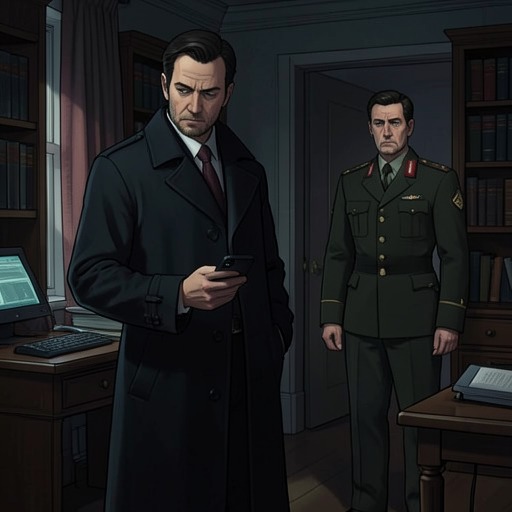
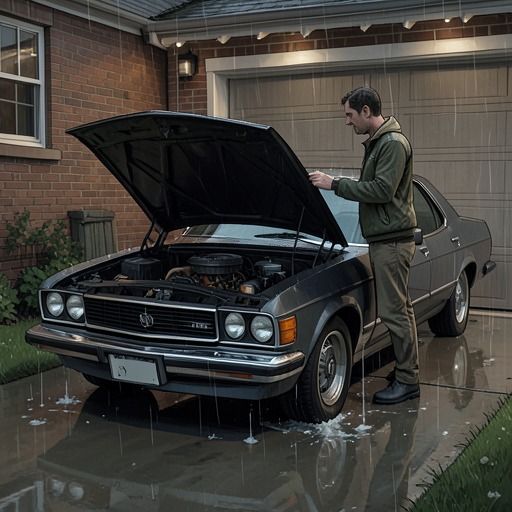
Rusty Regan’s abandoned car
The Big SleepRusty Regan’s abandoned car is the material clue around which the investigation into Rusty Regan’s disappearance repeatedly turns, without resolving it. A Packard associated with the wealthy Sternwood household, it is found in a private garage after Regan apparently drove away without explanation; its unexplained presence gives the police a location and a timeline, but no identified driver, usable prints, or settled account of the disappearance. The car becomes more than transport: it is evidence whose contradictory implications sustain the case’s uncertainty.
Identity and Place in the Investigation
The car is identified as the Packard 120 that belonged to Regan, who had been part of the Sternwood household. At the estate, a maroon Packard convertible stands in front of the white garage while a chauffeur dusts it, an image of polished, maintained property within the grounds. Later, the vehicle associated with Regan is no longer at home: his wife says he was given a Packard 120, while the police investigate a car that had been left in a garage without a known explanation. These details establish its privileged domestic setting and its later transformation into a missing-person clue.
When Vivian Regan speaks to Philip Marlowe, she says that Rusty drove away one afternoon about a month earlier without saying a word. His car was subsequently found in a private garage, though she offers no further account of who found it or how it got there. The fact that the car was recovered, rather than simply vanishing with its owner, gives the disappearance a physical trace. But the trace ends at the garage: it does not establish whether Rusty left voluntarily, was driven away by someone else, or met with violence.
Recovery and Police Evidence
Captain Gregory’s file dates Regan’s departure to September 16. It was the chauffeur’s day off, and nobody saw Regan take the car out. Four days later, a garage attendant reported the vehicle to the stolen-car detail because it did not belong at the private garage where it had been left. The garage belonged to the Casa de Oro, a bungalow-court property near Sunset Towers. Investigators could not discover who had put the car there, and the prints they found did not match anyone on file.
The lack of a known depositor or identifiable prints leaves the vehicle’s arrival unexplained. Gregory says the placement does not fit neatly with foul play, although the broader circumstances still give the police reason to suspect that possibility. He also treats the car as evidence that may fit another account, but the file does not establish that account as fact. The object therefore has a double evidentiary character: its location is concrete, while the act that placed it there remains unseen.
Competing Interpretations
The garage becomes significant when considered alongside the disappearance of Eddie Mars’s wife. Police find that she had been living at the Casa de Oro and had left within roughly two days of Regan. Someone resembling Regan was reportedly seen with her, but the witnesses could not positively identify him. The car’s location thus appears to connect Regan’s departure with the missing woman, yet the connection rests on circumstantial evidence and uncertain identification rather than a confirmed journey.
Gregory considers whether Regan was robbed and killed. Regan reportedly carried fifteen thousand dollars in cash, and the police know that others knew he had money. But Gregory doubts that an ordinary robber would have overcome a man experienced with firearms and with a history of commanding a brigade during the Irish troubles. Nor does the car’s presence at the bungalow court settle who knew of Regan’s alleged attachment to Mars’s wife. The vehicle can be made to support a robbery theory, but it does not prove one.
The police also consider the possibility that Regan and Mars’s wife left together. Gregory says they would have had a fourteen-day head start and might have used her car, since investigators did not find it. In that hypothesis, leaving Regan’s Packard at the Casa de Oro could be consistent with departure rather than murder. Yet the police do not know where the pair went, cannot confirm the reported sighting, and have no direct evidence that they traveled together. The abandoned car makes the elopement theory imaginable without making it certain.
Meaning and Narrative Function
The Packard connects spaces that otherwise belong to different social worlds: the Sternwood estate, where a chauffeur tends a convertible on immaculate grounds; the private garage at the Casa de Oro, where a stranger’s car is reported; and the investigative files in which its location becomes a clue to a wealthy man’s disappearance. Its movement away from the household does not produce a clear destination. Instead, the car’s found state—present, identifiable, and unexplained—marks the gap between what the police can document and what they can know.
That gap also shapes the novel’s handling of evidence. The vehicle gives the investigators a date, a place, and a lead to the bungalow court, but not the decisive fact they need: what happened to Regan. Its placement can suggest escape, concealment, or a crime, while the absence of prints and a reliable witness prevents any one reading from becoming conclusive. The Packard remains useful as evidence precisely because it is inconclusive; it keeps the disappearance legible as a case while preserving its central uncertainty.